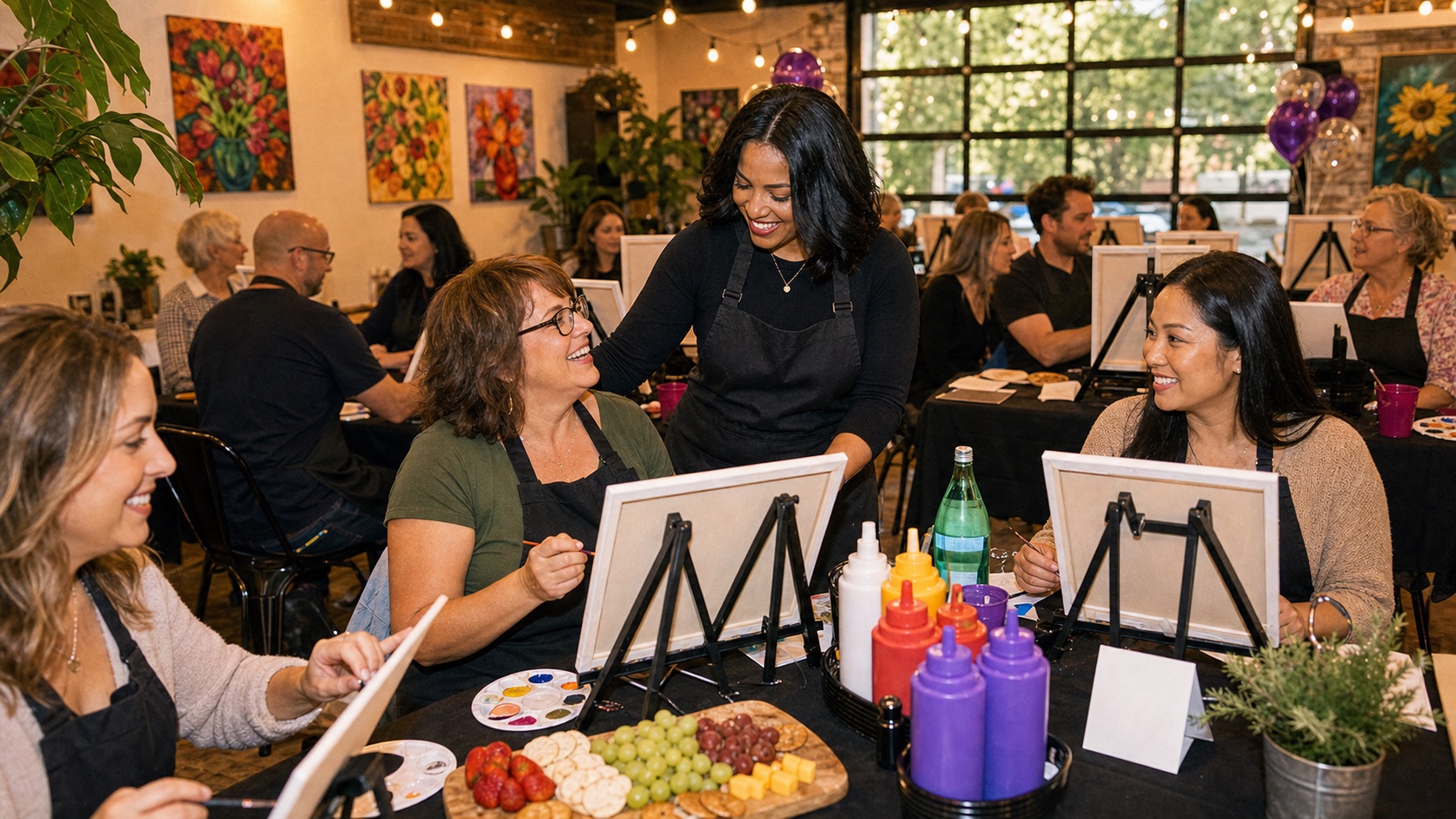
The next generation of paint studios is not really selling a canvas.
The canvas is still there, obviously. It matters. But the studios that feel strongest right now are selling a night out, a reason to gather, a little hosted magic, and a very clear next step for the customer.
That is the shift worth watching. The category is moving from "come paint this picture" to "come have this kind of evening." Date night. Team night. Pet portrait night. Birthday night. Splatter room. Private party. Fundraiser. Family afternoon. The full scoop is that customers are not searching for one generic class anymore. They are searching for the night that fits the reason they are going out.
For studio owners, that changes the business. It changes what should be on the website, what belongs in the booking flow, and what should happen after a guest leaves with wet paint in the back seat.
The old studio page is not enough
The old version of a paint studio page was basically a flyer. A logo, a few photos, a class calendar, maybe a paragraph about having fun with friends. Cute, but not enough.
Today, the studio page has to answer a more specific question: "Is this the right place for my thing?"
A customer planning a bachelorette party does not want to dig through a calendar full of Tuesday landscapes. A company admin does not want to guess whether the studio can invoice, host 28 people, or come to the office. A pet parent wants to know when the photo is due. A parent planning a birthday wants to know whether the mess stays at the studio. Please do not make these people hunt.
The best pages now explain the experience lane first. Public classes, private parties, corporate events, Paint Your Pet, kids events, mobile events, splatter sessions, and date nights all need slightly different proof.
The margin equation
A standard public class sells seats one at a time. That is not bad. Public classes create discovery, give regulars a reason to come back, and keep the calendar alive.
But private and experience-led formats can change the math.
One private inquiry can become a group booking. One corporate admin can bring a whole team. One Paint Your Pet night can support a higher ticket because the prep is custom and the customer is emotionally invested. One sold-out date night can become a repeat customer loop if the guest gets a smart follow-up before the next cute class drops.
The move is not to abandon public classes. The move is to stop treating every class like the same product.
What customers notice first
Customers notice clarity before they notice cleverness.
They want to know what kind of night they are booking, how much it costs, what is included, how long it takes, whether beginners are okay, and what happens next. If the page answers those questions quickly, the customer can relax.
That is especially true for higher-intent searches. Someone looking for a private paint party, corporate paint event, or Paint Your Pet class is already closer to buying than someone browsing for a random weekend activity. The page should meet that intent instead of giving them a generic studio bio.
Try it your way: write the first line like a friend making the plan.
"A relaxed private paint party for birthdays, team nights, and friend groups, with room setup, supplies, and guided instruction handled for you."
That sentence does more work than three paragraphs of "fun for all ages."
What owners need behind the scenes
Experience-led studios need cleaner behind-the-scenes systems.
The boring bit matters. A private party needs deposits, headcount deadlines, reminder messages, staff notes, setup time, payment status, and maybe a different cancellation rule than a public class. Paint Your Pet needs photo deadlines and prep status. Corporate events need a proposal, invoice language, and a way to keep the buyer updated.
If that work lives across texts, email threads, sticky notes, and a personal calendar, the customer may still have a nice night. But the owner is doing too much heroic admin. Cute until it is admin, naturally.
This is where a better workflow matters. A strong studio page gets the buyer to the right path. A strong booking process keeps that buyer from falling through the cracks.
Why paintandsip.co tracks intent
paintandsip.co tracks studios by use case because city alone is too blunt.
"Paint and sip Los Angeles" is useful, but it does not tell the whole story. A customer may need a splatter room, a mobile paint party, a pet portrait class, or a corporate-friendly studio. Those are different jobs.
The directory should help customers sort by what they are actually trying to do. It should also help owners see which offers deserve a clearer page, a better inquiry path, or a stronger follow-up sequence.
That is why the site separates city pages, occasion pages, studio profiles, owner guides, and tools. The editorial layer should explain what is happening in the market. The directory should help customers choose. The owner tools should help studios act on what customers are already asking for.

The three-page test
If a studio wants to feel more experience-led, start with three pages.
First, the public calendar. It should show what is coming up and make booking boringly easy.
Second, the private-event page. It should explain group sizes, occasions, pricing shape, deposit rules, and what happens after someone inquires.
Third, the signature-format page. That might be Paint Your Pet, splatter paint, date night, family classes, or corporate events. Pick the thing that customers already ask about and give it a proper home.
Each page should have one clear action. Book now, inquire, view private parties, or claim the listing. Fake buttons are not the move.
The offer ladder worth noticing
The highest-value studios usually have more than one way for a customer to buy.
Think of it as an offer ladder, not a random pile of classes. At the bottom is the easy public class: affordable, social, beginner-friendly, and simple to book. In the middle are signature formats like Paint Your Pet, date night, family workshops, splatter sessions, watercolor workshops, or seasonal events. At the top are private events, corporate groups, fundraisers, mobile parties, and custom bookings.
That ladder helps customers move naturally. A first-time guest tries a public class. Then she books a birthday. Then her office needs a team event. Then she buys a gift certificate for her sister. None of that happens if the studio treats every customer like a one-night visitor.
Best practice: every article, directory page, and studio profile should point the reader to the next useful step. A customer should find a class or venue. An owner should find the principle behind the idea, then shape a version that fits their own studio.
What the website should say out loud
The public site should say the useful thing plainly.
Not: "We offer unique creative experiences for all occasions."
Better: "Book a guided paint night for birthdays, team events, date nights, and private groups. We handle the supplies, setup, instruction, and cleanup."
That kind of sentence works because it speaks to the planner. She is not trying to decode a brand mood. She is trying to make a plan that will not embarrass her. Bless her. She has enough tabs open.
For studio owners, the page should also make one business promise visible: "We know how to host this kind of event." That can show up through photos, package names, deposit rules, photo deadlines, group-size details, or a clean inquiry path.
The calendar will tell on you
Experience-led studios do not have to guess forever. The calendar gives receipts.
If Paint Your Pet sells out faster than landscapes, give it a stronger page. If weekday corporate inquiries come in but never close, fix the proposal and deposit flow. If date nights sell but nobody comes back, add a repeat-customer email. If private parties are profitable but chaotic, simplify the package menu.
The move is to watch what customers already try to buy, then make that path cleaner.
Track simple signals:
- Which pages get inquiries.
- Which classes sell out first.
- Which private-event leads convert.
- Which guests return within 60 days.
- Which formats create the most staff stress.
That last one matters. A format that looks cute online but wrecks the team every Friday is not a premium lane yet. It is a future-you problem wearing a cute apron.
The owner takeaway
The studios that feel newest are not always the ones with the trendiest decor. They are the ones that make the customer feel handled.
The buyer knows what they are booking. The host knows what happens next. The staff knows what to prep. The calendar has a plan beyond "post more classes and hope."
That is the experience-led studio. It is still warm, creative, and social. It just has better receipts.
Sources
These sources ground the editorial examples. They do not imply the listed studios use Painta unless a profile is marked Painta-powered.
- Painta-powered Artbar Tokyo listing
Shows the claimed/Painta-powered profile state and live booking path used as the directory showroom.
- Private paint party directory intent
Directory private-party listings ground the article's private-event demand claims.
- Corporate paint and sip directory intent
Directory corporate-event listings ground the article's group-event and owner workflow claims.
- Repeat-customer calendar guide
Owner guide used for the retention, return-visit, and calendar-planning recommendations.